

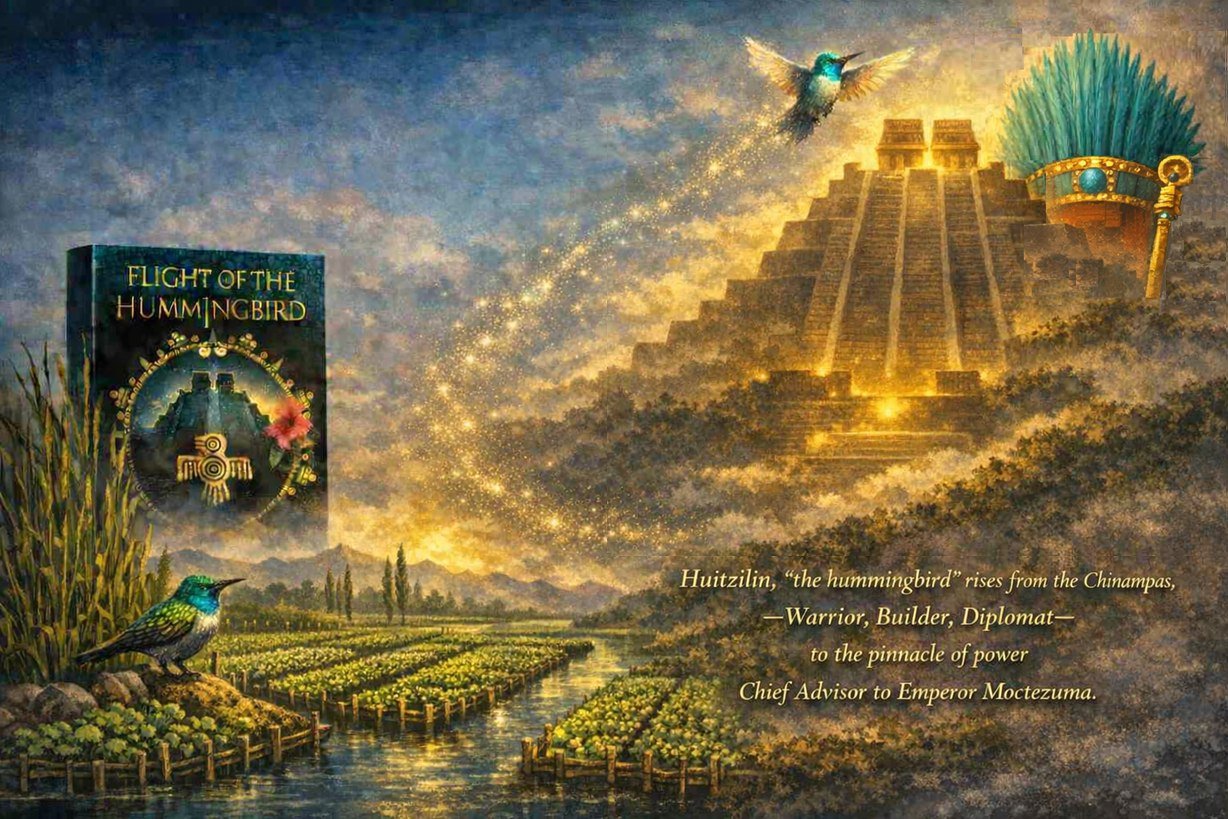
Historical fiction has a unique ability to transport readers beyond dates, battles, and familiar historical events. The best historical novels allow us to experience the emotions, ambitions, traditions, and everyday lives of people who lived centuries before us. Flight of the Hummingbird, a novel by Salomón Quintero, offers such an experience by taking readers deep into the world of the Mexica and the extraordinary city of Tenochtitlán.
Set against the final years of a powerful civilization, Flight of the Hummingbird combines history, culture, family, ambition, and prophecy into a compelling story. The novel follows Huitzilin, known as “the Hummingbird,” as he rises from an ordinary family background to become a trusted adviser to Emperor Moctezuma II.
Discovering the Mexica World
When many people think about the Aztec civilization, they often think only of temples, warriors, sacrifice, and the arrival of the Spanish. Flight of the Hummingbird invites readers to look beyond these familiar images and discover the human world that existed within the Mexica civilization.
The story presents Tenochtitlán as a vibrant center of culture, commerce, craftsmanship, education, politics, and artistic achievement. Through the experiences of one family, readers can explore different levels of Mexica society and understand the aspirations that shaped people’s lives.
Huitzilin’s family represents this dynamic society. His father becomes a respected jeweler and philosopher-artist, while his brother develops into a successful merchant and his sister becomes a celebrated feather artist. Their individual journeys demonstrate the importance of talent, creativity, education, and ambition within the society.
The Story of Huitzilin
At the heart of the novel is Huitzilin’s remarkable personal journey. His path takes him from the chinampas of Tenochtitlán into the elite Calmecac school, where he receives an education and develops relationships with members of the ruling class.
Education becomes an important part of Huitzilin’s transformation. His experiences at the Calmecac help prepare him for a life involving warfare, diplomacy, leadership, and statecraft. Eventually, his abilities allow him to rise to the position of chief adviser to Emperor Moctezuma II.
His journey also raises an important question: how much can an individual change his or her position in society?
This question is central to the author’s motivation for writing the novel. Quintero explains that the story began with a debate about social mobility and the idea that Mexica society was completely static. His research led him toward a more complex understanding of the civilization—one in which ambition, talent, achievement, and individual opportunity could influence people’s lives.
Tenochtitlán: A Civilization at Its Height
One of the fascinating aspects of Flight of the Hummingbird is its focus on the Mexica world before its dramatic collapse.
Tenochtitlán was the center of an impressive civilization, and the novel allows readers to imagine the city not simply as an archaeological site but as a living community filled with artists, merchants, students, warriors, leaders, craftspeople, and families.
The story moves through different generations, showing how one family experiences the rise and transformation of Mexica society. Their personal ambitions are connected to the larger political and cultural world around them.
This approach makes historical fiction especially powerful. Instead of presenting history as something distant and abstract, the novel gives historical events a human dimension.
When Prophecy Meets History
As Huitzilin and his family reach the height of their success, the atmosphere surrounding them begins to change. Omens appear, uncertainty grows, and rumors begin to spread about strangers arriving from the eastern sea.
The arrival of unfamiliar outsiders represents a threat that the Mexica world has never experienced before. A civilization that has developed its own political systems, traditions, art, education, and philosophy suddenly faces an unpredictable challenge.
This combination of historical events and the novel’s theme of prophecy creates an atmosphere of suspense. Readers know that the world Huitzilin has dedicated his life to strengthening is approaching a moment of extraordinary change.
The title Flight of the Hummingbird therefore carries a sense of movement, transformation, and fragility. Huitzilin’s personal journey becomes connected to the fate of an entire civilization.
Cultural Heritage and Historical Memory
Historical novels can also play an important role in encouraging readers to think differently about cultural heritage. By presenting the Mexica as individuals with dreams, families, professions, artistic interests, political ambitions, and philosophical ideas, Flight of the Hummingbird seeks to restore a human dimension to a civilization often reduced to simplified historical descriptions.
The novel’s focus on artisanship is particularly significant. Jewelry, feather artistry, commerce, education, and philosophy all become part of the larger picture of Mexica life. These details help demonstrate that civilizations are built not only by rulers and warriors but also by artists, educators, merchants, craftspeople, and families.
For readers interested in Aztec history, Mexican history, Indigenous cultures, or historical fiction, the book offers an opportunity to explore these themes through the personal story of Huitzilin.
Why Read Flight of the Hummingbird?
Readers who enjoy historical novels often look for stories that combine authentic historical settings with compelling characters. Flight of the Hummingbird offers both.
It is a story about ambition and social mobility, but it is also a story about family, identity, culture, leadership, and the uncertainty of the future. Huitzilin’s rise provides the personal narrative, while the transformation of the Mexica world provides the larger historical backdrop.
The novel is particularly interesting for readers who want to understand the people behind history rather than simply memorize historical events. It encourages us to consider what people valued, what they feared, what they hoped to achieve, and how they responded when their world began to change.
A Historical Journey Worth Exploring
Flight of the Hummingbird presents the Mexica world at a crucial moment in history. Through four generations of one family, readers witness a civilization’s creativity, ambition, cultural richness, and eventual confrontation with forces beyond its control.
At its center is Huitzilin—a man whose journey from the chinampas to the highest levels of political influence reflects the possibilities of individual ambition within a complex society. His story also becomes a window into the final chapter of a civilization that continues to influence how we understand the history and cultural heritage of Mexico.
For anyone interested in historical fiction, Aztec history, the Mexica civilization, Tenochtitlán, or stories about individuals who rise through education and determination, Flight of the Hummingbird offers a fascinating journey into the past.
The novel invites readers not merely to observe history from a distance, but to experience the Mexica world through the eyes of the people who lived within it.


